

Feature requests are one of the most useful forms of customer feedback, but they can also become noisy fast. One customer asks for an integration. Another wants a dashboard. A third asks for a workflow that sounds small but would change the product architecture.
The job of a product team is not to build every request. It is to understand what the request reveals, decide whether it supports the product direction, and communicate what happens next.
What Counts as a Feature Request?
A feature request is any customer signal that asks for a product change. It can be:
- A new feature idea
- An improvement to an existing workflow
- An integration request
- A reporting or export need
- A customization request
- A repeated workaround that suggests a missing capability
Bug reports are different, but they often sit next to feature requests in the same customer feedback flow. A strong bug reporting workflow keeps defects separate from improvement ideas while still giving product and engineering shared context.
Collect Requests from Every Channel
Feature requests rarely arrive in one tidy place. They show up in live chat, support email, sales calls, onboarding sessions, surveys, community threads, churn notes, and in-app feedback.
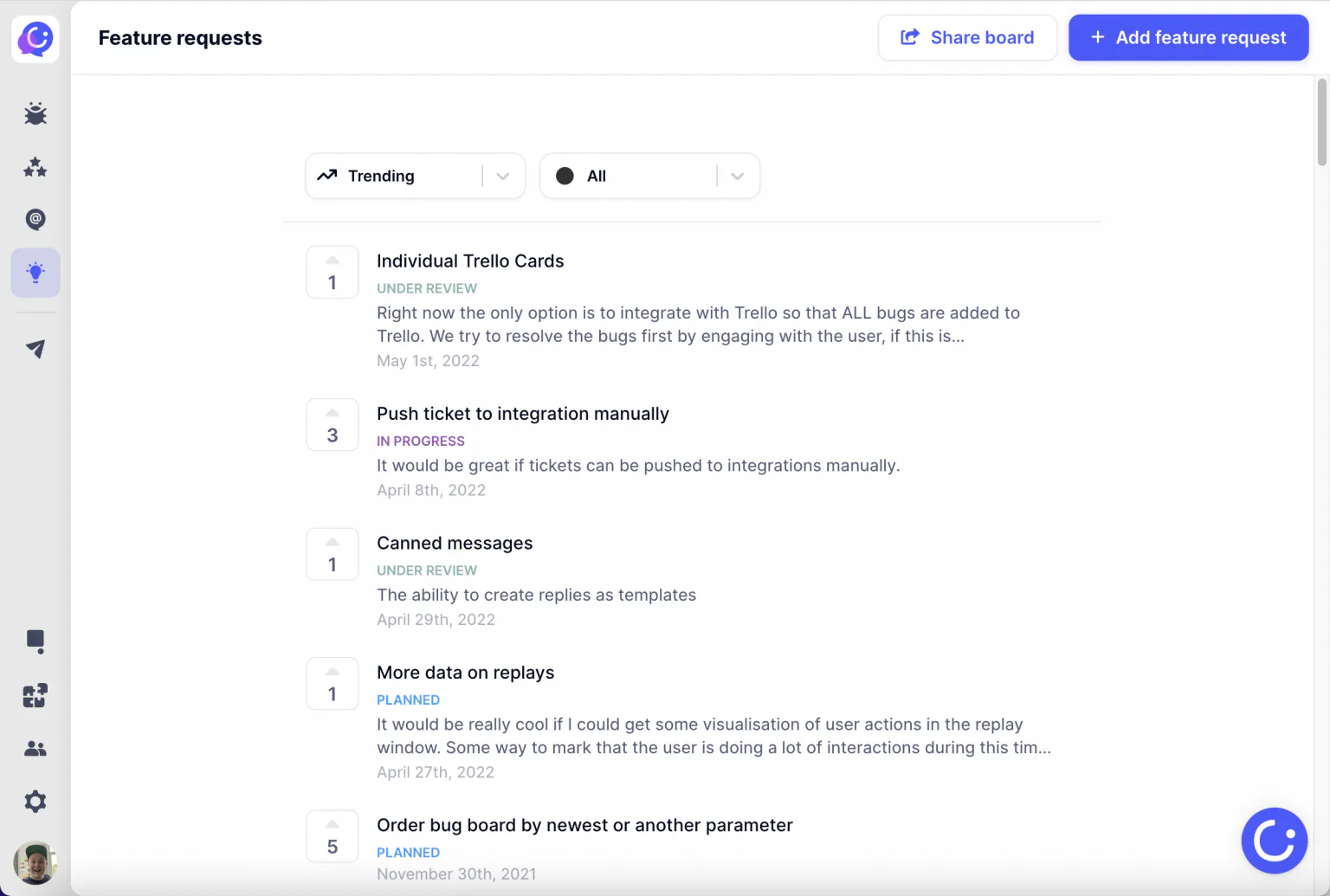
The first step is centralization. Use a dedicated public roadmap and feature request board so customers can submit ideas, upvote existing requests, and follow status changes. Then connect that board to support and success workflows so internal teams can add context when they hear the same request in conversations.
Qualify the Request Before Scoring It
Do not jump straight from “customer asked” to “roadmap item.” First, clarify the need:
- What problem is the customer trying to solve?
- How are they solving it today?
- How often does the problem occur?
- Which segment does it affect?
- Is the request about a missing feature or a confusing existing workflow?
- Would documentation, onboarding, or a smaller product change solve it?
This step prevents teams from building literal requests when the underlying problem needs a different solution.
Prioritize with a Consistent Framework
The framework can be simple. Score each request against:
- Demand: How many customers asked for it?
- Impact: Does it affect activation, retention, expansion, or support volume?
- Segment: Are strategic customers or ideal-fit users affected?
- Fit: Does it align with the product strategy?
- Effort: How complex is the change?
- Confidence: How strong is the evidence?
Some teams use RICE, impact-versus-effort, opportunity scoring, or a custom model. The specific method matters less than using it consistently and revisiting decisions as new evidence arrives.
Avoid the Loudest-Customer Trap
The loudest customer is not always wrong, but volume and urgency can distort priorities. A single large account may request a niche workflow. Many small accounts may ask for the same improvement. A quiet usability issue may create more churn than a flashy feature request.
Look for patterns across channels. If a request appears in surveys, support conversations, sales objections, and churn notes, it deserves more attention than a one-off ask.
Close the Loop
Feature request management does not end with prioritization. Customers should know what happened:
- Under review: “We are exploring this and gathering more context.”
- Planned: “This is on the roadmap.”
- Released: “The feature is live.”
- Not planned: “We are not prioritizing this right now, and here is why.”
Closing the loop builds trust even when the answer is no. It also improves future feedback because customers learn what kind of input helps your team make decisions.
For a deeper workflow, read our guide on closing the customer feedback loop.
How Gleap Helps
Gleap connects feature requests, roadmap voting, customer conversations, and product context in one place. With Kai PM, teams can also turn recurring customer signals into clearer product direction and keep customers informed as requests move through the roadmap.
Better product decisions come from better evidence. Feature requests are the raw material; the process around them is what turns them into a roadmap your team can trust.