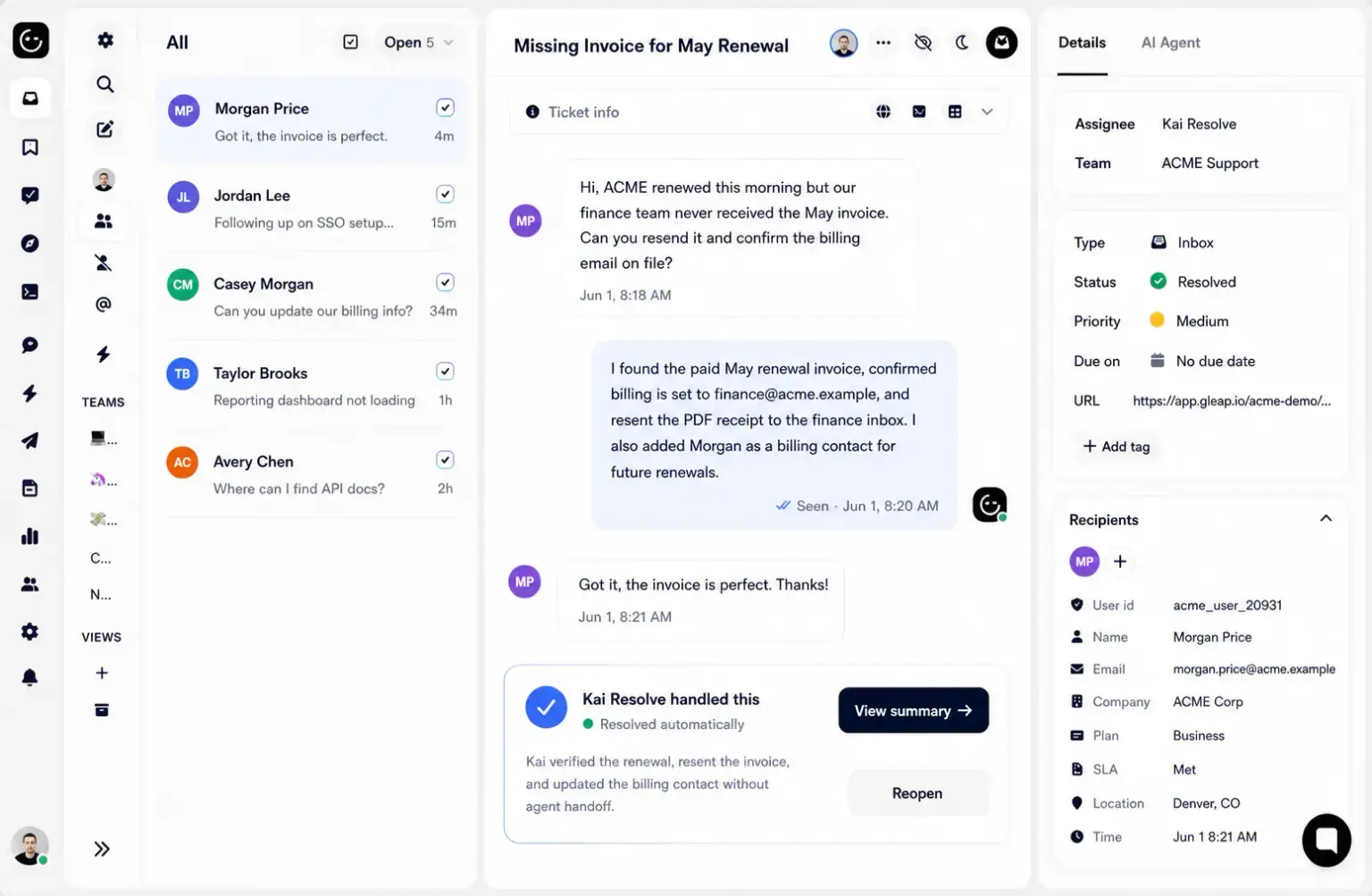
Kai reads the inbound, checks your knowledge base and past tickets, and either resolves it or routes it. ~80% never needs a human.

Kai Resolve digs deeper
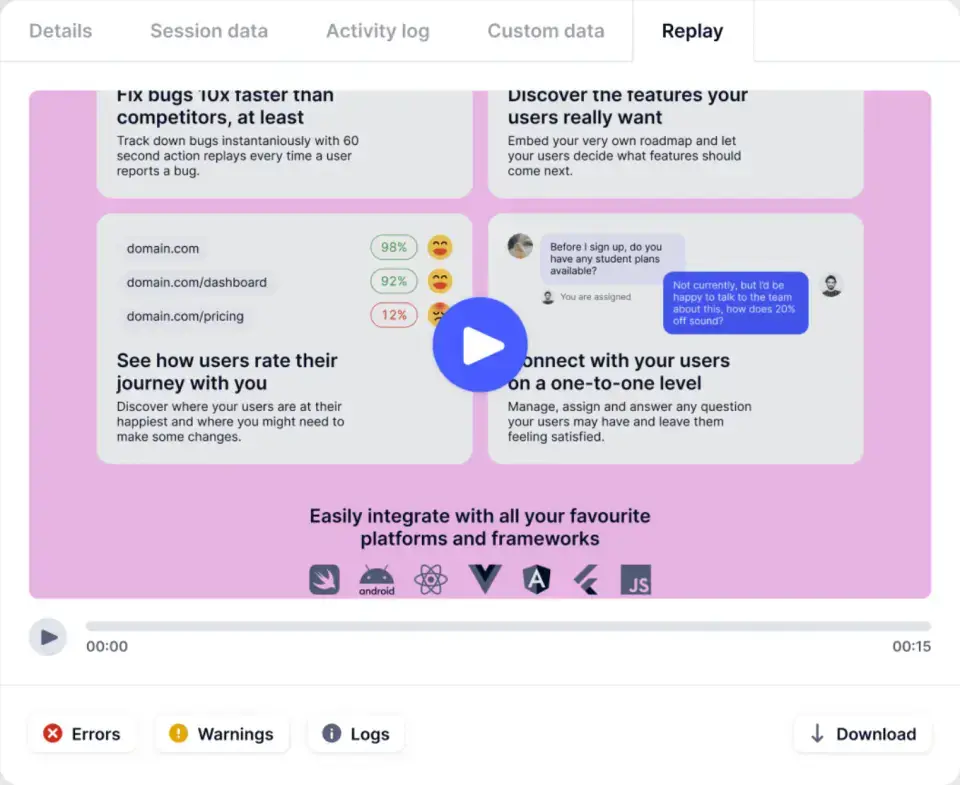
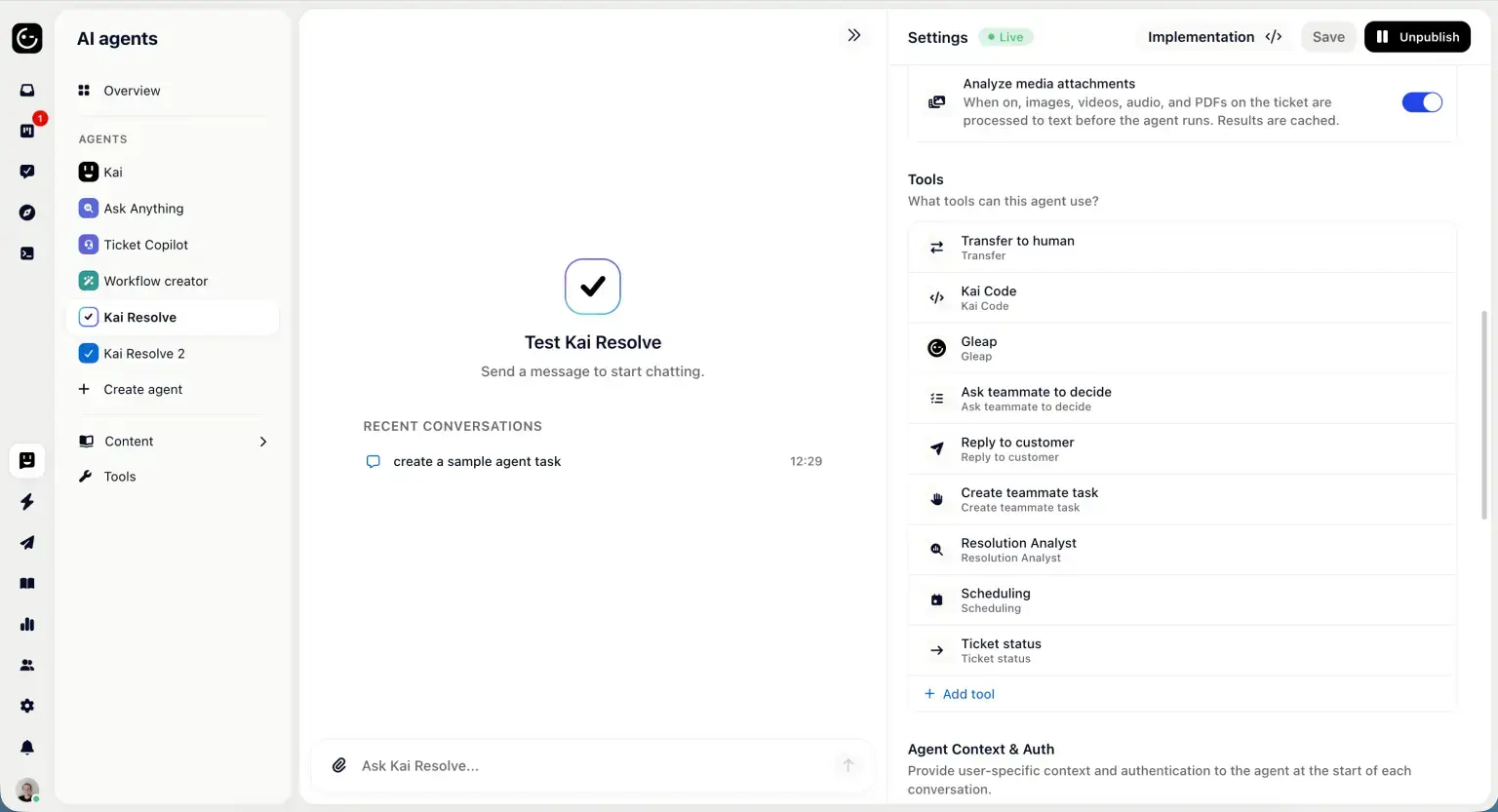
Escalations go to Kai Resolve first. It reads session replay, MCP tools, source context, read-only data, Stripe, Salesforce, APIs, and ticket history. Then it routes the next step.

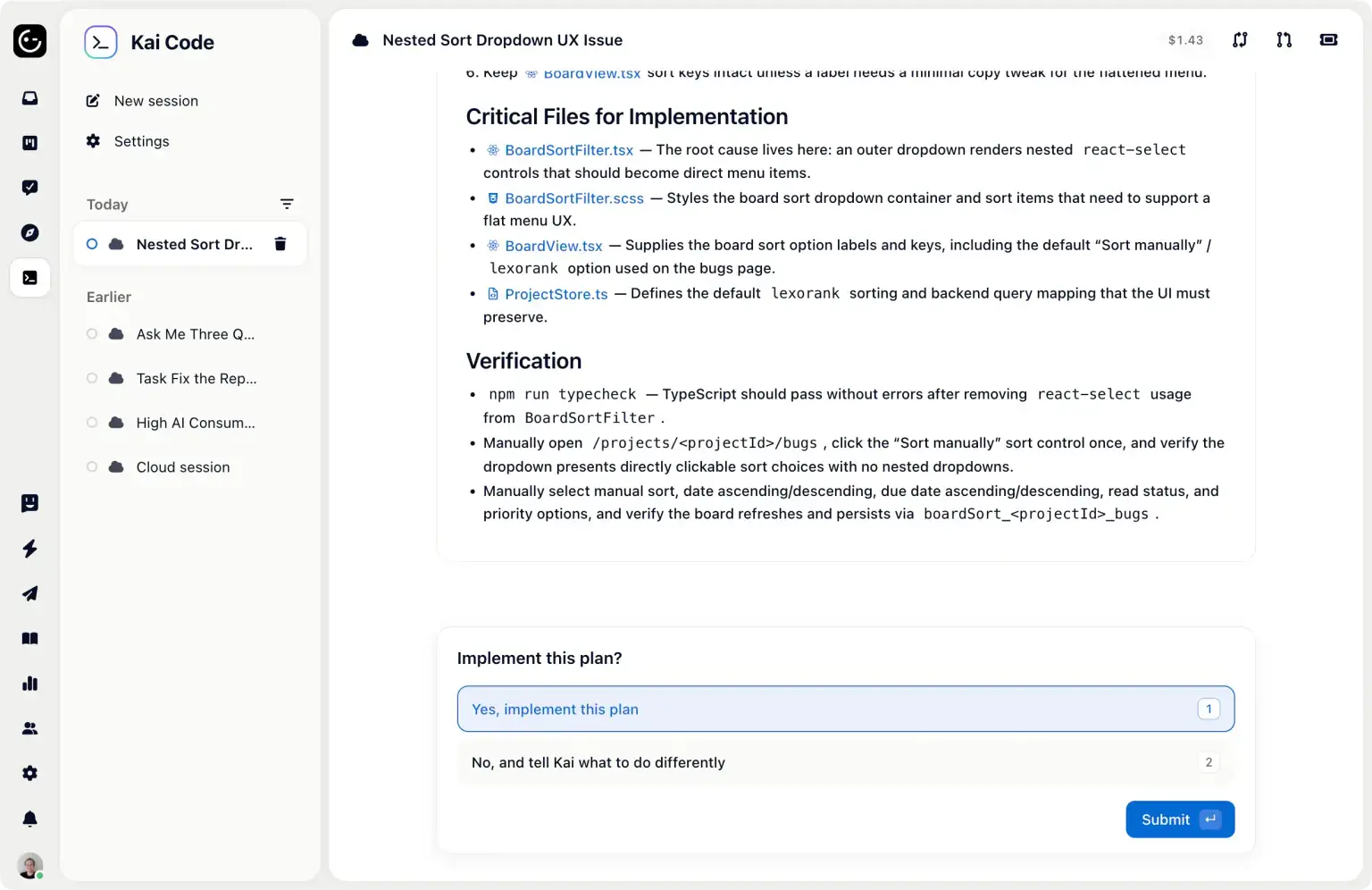
Kai Code opens the PR
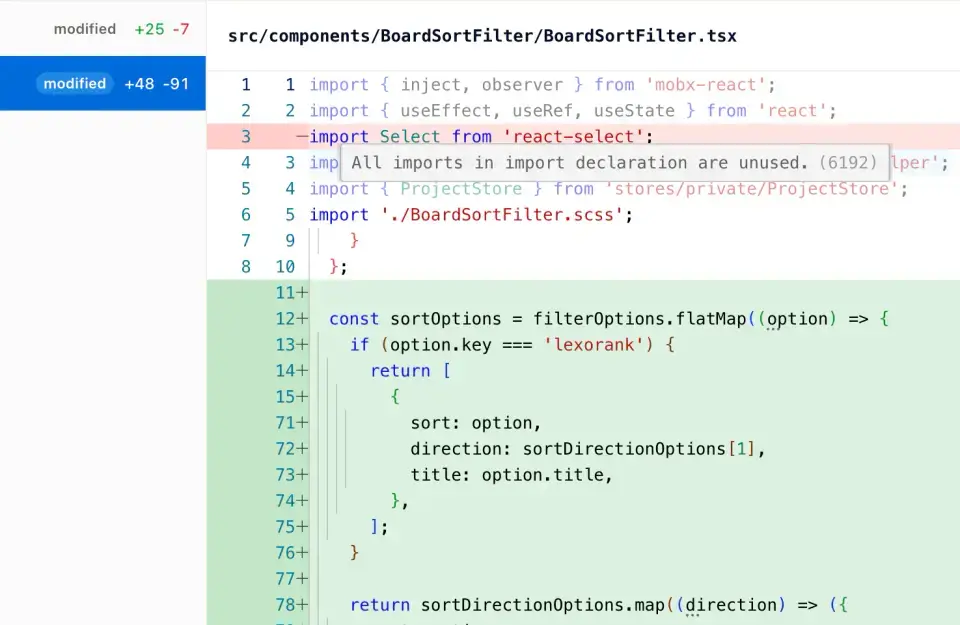
Confirmed bug → Kai Code receives the full context. Plan mode scopes the change. Build mode implements it, runs checks, and opens the PR. Your engineer reviews and merges.

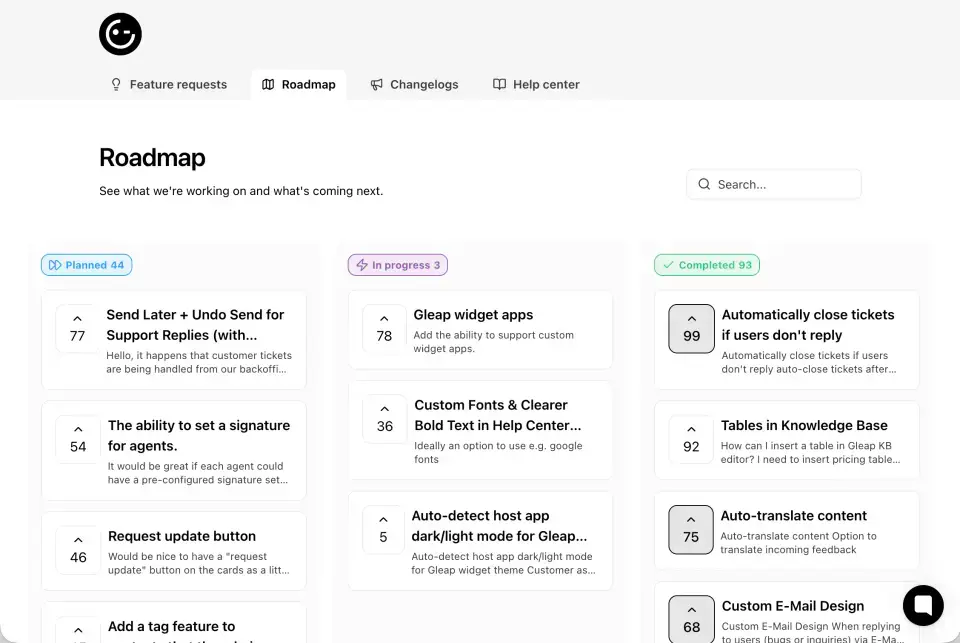
Kai PM turns requests into the roadmap
Feature requests flow through Kai PM. It validates demand, scores by revenue, writes the spec, hands approved work to Kai Code, and writes the release notes when it ships.

The customer hears back
PR merged. CI deploys. The customer who reported it gets told - by name, in their channel of choice - that it's fixed. The loop closes.

Gleap team’s super-fast turnaround time on delivering new feature requests creates a winning and indispensable combination for the elimination of errors from your code.
Martin Hardman
Transaction Network Services
vs Intercom Fin, Sierra, Decagon
Support-side agents stop at the conversation.
Sierra, Decagon, Fin handle the conversation. They don't read your code, don't open PRs, and don't tell the customer when the fix ships. Gleap connects support to engineering.
Devin, Cursor agents, Copilot - all developer-initiated. The customer who reported the bug doesn't exist in their context. Gleap's self-driving development starts with the customer and ends with the customer notified.
Software teams ranging from indie founders to Microsoft, Squarespace, UNICEF, Papa Johns running their loop on Gleap.
<1 day
Salesforge setup and migration
Salesforge imported contacts and help center articles in minutes, then moved support, roadmap, news, outreach, and Slack into one Gleap workspace.
10 days
Partfox full integration
Partfox fully integrated Gleap with custom data and unlocked live chat, AI support, feedback, product tours, checklists, and surveys.
The closed-loop FAQ
What does "close the loop on customer feedback" mean?
Closing the customer feedback loop means the customer who reported an issue gets told, by name, when it has been fixed, shipped, or planned. In software teams, that loop usually spans triage, investigation, coding, review, merge, deploy, release notes, and customer acknowledgement. Most companies leave the loop open because each step lives in a different tool and requires manual follow-up. Gleap closes the customer feedback loop with AI agents: Kai triages the inbound, Kai Resolve investigates complex issues, Kai Code prepares pull requests, Kai PM handles feature demand, and Gleap notifies the original customer when the work is done. The result is a customer-to-code workflow where support, product, and engineering share one source of context instead of passing screenshots, tickets, and status updates between disconnected systems.
How does the customer-to-code loop actually work?
Specialist agents hand off to each other: Kai triages the inbound. Kai Resolve investigates with MCP tools, source context, read-only data, CRM, APIs, and past tickets. Confirmed bugs go to Kai Code for plan mode, build mode, checks, and a pull request. Your engineers review and merge. Gleap notifies the original customer that their bug is fixed. Feature requests flow through Kai PM, which prioritizes demand, hands approved specs to Kai Code, and closes the release loop.
How is this different from Cursor's self-driving codebases?
Cursor's self-driving codebases is developer-initiated - an engineer kicks off a swarm of background agents. Gleap's loop is customer-initiated - a real customer report triggers the chain, and the original customer gets notified when the fix ships. Cursor stops at the codebase; Gleap closes the loop back to the customer. The two systems aren't competitors. Cursor optimises the engineering side; Gleap connects support to engineering and back to the customer.
How is this different from Intercom Fin or Sierra?
Intercom Fin and Sierra are support-side AI agents. They focus on the customer conversation. Gleap connects support to engineering: Kai Resolve investigates complex issues, passes confirmed bugs to Kai Code for plan and build, and the customer gets told when the fix ships.
Will my engineers still control what gets merged?
Yes. Kai Code opens pull requests; your engineers review and merge them. Gleap is the autopilot for the work between customer report and PR-ready code - not a replacement for code review. Every PR includes the original customer report, session replay link, console logs, relevant code context, and the proposed diff. Engineers spend under 5 minutes confirming a fix that would have taken 45 minutes from scratch. Auto-merge thresholds for low-risk fixes are configurable.
What if my company has a workflow that's unique to us?
That's what Kai Custom Agents is for - a no-code AI agent builder running on Gleap's customer data and 40+ native + 1,000+ Composio integrations. Common custom agents: churn defenders, competitor monitors, revenue-signal agents, CS-sync agents. Custom agents start on Pro.
Does Gleap replace my existing support, bug reporting, and roadmap tools?
For most teams, yes. Gleap replaces Intercom (or Zendesk), Instabug (or Usersnap), Canny, and Productboard with one $149/mo subscription. Teams typically consolidate 4-5 tools and cut their support tooling spend ~70% in the first month. See pricing and the Intercom comparison.
Stop maintaining software. Start building your vision.