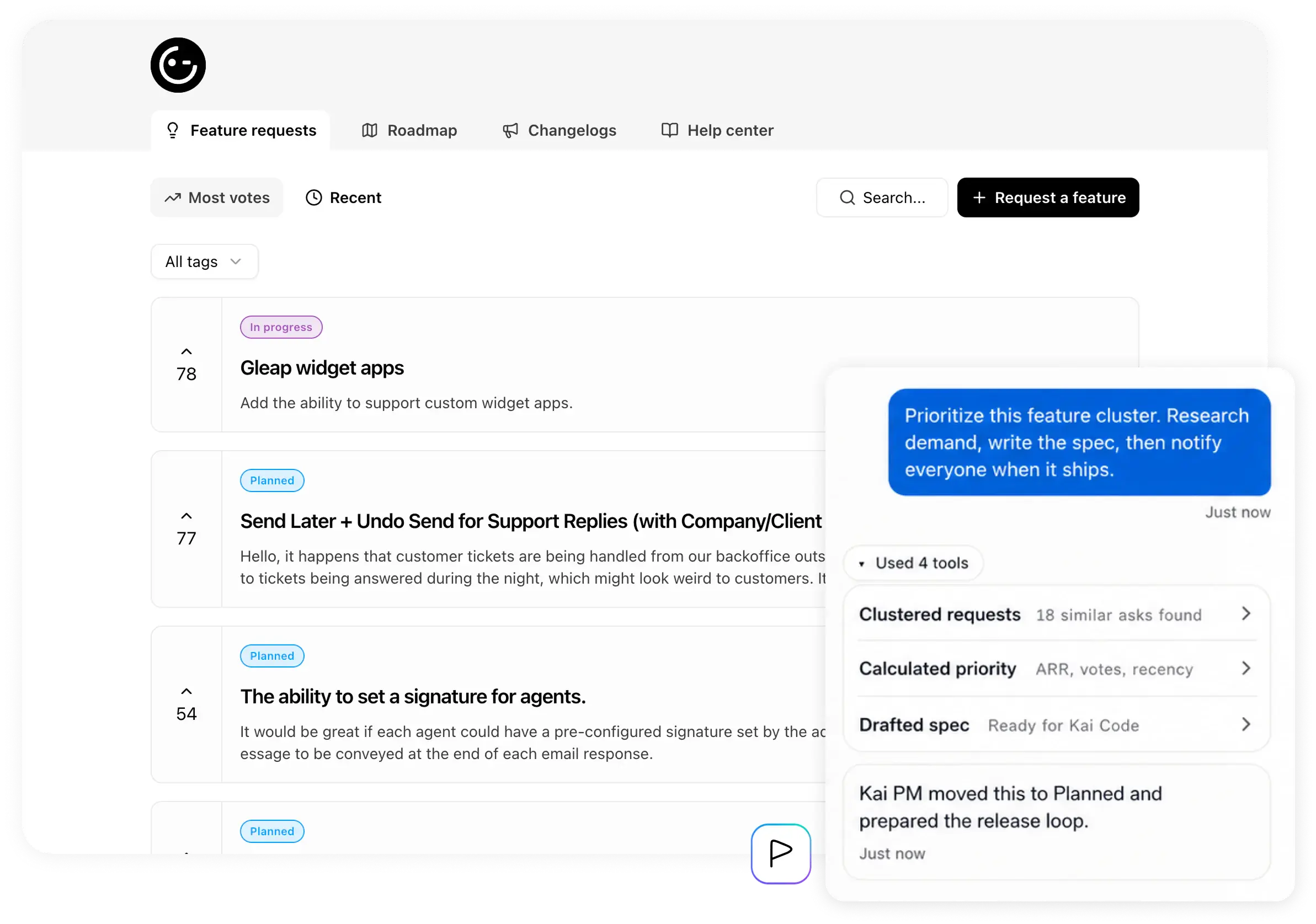
Reads every support ticket, feature vote, NPS comment, and survey response - synthesizes them into structured feature specs. Not a vague idea. A spec, complete enough for an engineer or Kai Code to act on.
Revenue-weighted prioritisation
Every roadmap item gets a priority score - vote weight × plan tier × ARR + strategic fit + market urgency + recency. Recalculated automatically as new votes, tickets, and customer signals arrive.
Reads every channel
Direct feature requests, votes, surveys, support themes, in-app messages, and product gaps routed by Kai Resolve.
Web research built in
Monitors competitor changelogs, app store reviews, market shifts.
Hands off to Kai Code
Approved specs become Kai Code plan-mode inputs, build-mode runs, and pull requests.
Closes the loop
After merge, Kai PM writes release notes and notifies the customers who asked for the feature.
Roadmap that recalculates itself
No more quarterly shuffle.
Vote weight × plan tier × ARR + strategic fit + recency - Kai PM scores every item and re-scores as new signals arrive. You review, adjust, override.
Writes the release notes the moment Kai Code ships
The loop closes automatically.
When Kai Code creates a pull request and it gets merged, Kai PM turns the shipped work into customer-facing release notes and notifies every customer who asked for it - individually. Not a mass blast. "The feature you requested is now live."
Kai PM is Gleap's AI product manager. It reads customer feedback from every channel (support, feature votes, NPS, surveys, in-app), clusters by underlying need, writes structured feature specs with built-in web research and competitive context, prioritises with revenue-weighted scoring, and writes release notes. On Pro, approved specs can hand to Kai Code for plan mode and build mode.
How is Kai PM different from Canny?
Canny is a feature voting board with manual triage. Kai PM auto-collects feedback from every channel (not just a vote board), clusters semantically, scores by revenue impact (not just vote count), and writes release notes automatically. Pricing: Canny charges per tracked user (~$79/mo and up); Kai PM is available on Gleap Pro at $299/mo with unlimited seats, and usage is billed by actual tokens and selected model. See the Canny alternative.
How is Kai PM different from Productboard?
Productboard is enterprise PM software with manual workflows - collect, prioritise, plan, all manually. Kai PM does the product work autonomously, and Pro can close the implementation loop through Kai Code. Productboard starts at ~$25/maker/mo; Kai PM is available on Gleap Pro at $299/mo with unlimited seats, and usage is billed by actual tokens and selected model. See the Productboard alternative.
How does revenue-weighted prioritisation work?
Every vote is multiplied by the voter's plan tier and ARR. A request from a $50k/yr customer outweighs one from a $0 user. Strategic fit and market urgency add modifiers; recency surfaces trending requests ahead of stale ones. The result is a roadmap that reflects your customers, your business, and your market - not raw vote counts.
Can I override Kai PM's priorities?
Always. Kai PM proposes a prioritised starting point. You review, adjust, and approve. Or set thresholds so Kai PM proceeds autonomously for lower-stakes items while keeping high-stakes decisions in your court.
How does Kai PM write release notes?
After a feature ships, Kai PM drafts customer-facing release notes (benefit-led, not engineering changelog), publishes to your in-app news feed and public changelog, and notifies every customer who voted or mentioned the feature in support. Not a mass blast - a targeted, personalised notification per voter.
Does Kai PM support Jira or Notion?
Yes. Jira and Notion can mirror roadmap status, spec context, and customer demand. On Pro, the actual implementation handoff can go to Kai Code: approved spec, plan mode, build mode, PR, merge, then release notes and customer notifications.
Stop drowning in feedback. Start shipping the right thing.